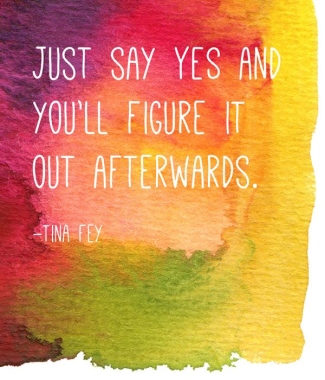
I love improv comedy because of its authenticity. You might ask me, how can a dramatic form where the performers are literally making everything up as they go possibly be authentic? To that I would say, “Yes, and… Fuck, I really should’ve thought that one through.”
I’ve always been a fan of comedy, but five years ago, if you had asked me to go to an improv show, I would have passed, saying (or at least thinking), “It may be a great way for comedians to hone their skills–to build those 10,000 hours–but I want to watch their best, painstakingly edited final product, not their practice session.”
Last night, I was walking down a crowded street, earbuds in, listening to Comedy Bang Bang, trying desperately not to laugh in public. My face was so lit up by the comedy, that it drew multiple strangers to Continue reading ‘How a Neuroscientist Came Around to Improv Comedy’
Filed under: Uncategorized | Leave a Comment

“Autism is about having a pure heart and being very sensitive… It is about finding a way to survive in an overwhelming, confusing world… It is about developing differently, in a different pace and with different leaps,” Trisha Van Berkel.
How do genes—DNA, these physical atoms: carbons, hydrogens, and nitrogens—influence our subjective experience of consciousness? And how can mutations to genes lead to the alterations in behavior and consciousness seen in disorders like autism?
Autism Spectrum Disorder (ASD) is now estimated to affect 1 in 68 children in the United States and causes difficulties with social interaction, and a tendency towards repetitive behaviors and restricted interests. A surprising new study published in Cell indicates that two well-studied mutations that cause autism may actually be acting outside of the brain, and an oft-overlooked symptom may be more important than we’ve thought.
Filed under: Uncategorized | Leave a Comment
I wasn’t suicidal — I was just curious what would happen if I labeled my video ‘suicide.’
Surely, the live-streaming app, that had months before been bought by the $10 billion dollar company Twitter, must’ve realized someone would do this. I imagined a notification would pop up, advising me who to call if I needed help, but no, the post went through.
Suicide, evidently draws a crowd. Instantly, fifty people joined compared to my usual two or three viewers. Sitting next to a male friend, some messaged homophobic slurs and goaded me on to suicide.
But it wasn’t all bad. Concerned people asked if I was okay. When I explained I had just wanted to see what happened, many informed me what I was doing was irresponsible — one person shared a story about her father had committed suicide on the exact same day a year before.
I felt terrible about that.
But more than that I felt Periscope, should’ve predicted that one day someone would try to livestream their suicide attempts. And in those crucial moments, I wanted the app to give a warning, an easy option to get help, instead of a crowd of anonymous potential bullies.
Three months ago, a French 19-year-old, did it for real.
While the internet may be guilty Continue reading ‘A year ago, I typed ‘suicide’ into Periscope and hit stream — Why aren’t we using social media to screen for mental illness and offer access to care?’
Filed under: Uncategorized | 8 Comments
3,250 meters above the sea and 1,000 meters above the clouds, in a wooden cabin that fits 250 people into bunks like sardines…
Continue reading ‘Everything changes at once (nothing ever changes)’
Filed under: Uncategorized | Leave a Comment

“We’ve all been raised on television to believe that one day we’d all be millionaires, and movie gods, and rock stars. But we won’t. And we’re slowly learning that fact. And we’re very, very pissed off.”―Chuck Palahniuk, Fight Club
After Fight Club was published in 1996, our dreams have further devolved and divorced themselves from aspirations of talent. Now we just want to be loved and famous. Why aim high and put all the work into becoming a rock star, when you can just ride someone’s coat-tails Entourage style or become the next Kim Kardashian?
Are Millennials the most narcissistic generation yet? Fueled by our self-esteem obsessed culture, and exemplified by children’s song lyrics like “I am special, I am special, look at me…” That’s the argument San Deigo State personality psychology professor Jean Twenge has been making in several books, and recently, where I heard it, on NPR’s Brain Matters podcast. I’ve heard this sentiment made before. Indeed, most Millennials have heard this sentiment and have internalized it[1].
But is it true?
Are Millennials really narcissists? Continue reading ‘Are Millennials Really Narcissists?’
Filed under: Uncategorized | 6 Comments

Monkey see, monkey do. We may not be monkeys, but we frequently ape others, mirroring their posture, behavior mood. When we act angrily, others respond with anger. When we act kindly, others respond in kind.
Invisibilia’s latest episode looks at what we can do when we flip this script, and respond in an unexpected way with non-complementary behavior. Here I’ll discuss some of science mentioned in the show and extend it into the wonderful world of mirroring to teach you a very important life skill–how to spot the coolest dude in the room.
So what is non-complimentary behavior?
See example 1 of armed robbery, wine, and non-complimentary behavior from the show illustrated with puppets:
And example 2, eerily similar story of armed robbery, wine, and non-complementary behavior Continue reading ‘Breaking the Feedback Loop: How non-complementary behavior can save your life. Also, how to know ‘Who’s the coolest guy in the room?’’
Filed under: Uncategorized | 1 Comment

A recent Invisibilia episode discusses frames of reference—the frames we use to interpret our world—and how our own frame of reference can clash with that of others, even our own family. For immigrants and their children, differences in culture, generation, class, and historical context lead to dramatically different frames of reference—after all what is a little bullying in school compared to the Holocaust. My own non-immigrant father’s stories of waking up at 5am to milk the cows before going to school made me grateful for my upper-middle class suburban life and guilty if I messed up in school.
But frames of reference extend far past Continue reading ‘Frames of Reference – Why Smart People Feel Stupid, Money Buys Happiness, and You Will Never Feel Truly Satisfied’
Filed under: Uncategorized | 4 Comments
We can’t quite read thoughts yet, but we’ve gotten pretty good at figuring out what sorts of things you’re hearing about.
Check out this amazing video recently released alongside the publication from Huth et al. of the Gallant Lab, and then read my summary below of how they achieved this. This is the first study to study the semantic system of the brain using a data-driven approach to determine semantic categories in an unbiased way.
Continue reading ‘One step closer to reading minds, the representation of words in the brain.’
Filed under: Uncategorized | Leave a Comment
Neurology cannot directly explain the emergence of qualia (subjective experience), but it can study the circuitry that might be necessary for it’s emergence by using case studies of people who have experience brain damage and also techniques such as Transcranial Magnetic Stimulation (TMS) that can reversibly disrupt brain areas.
For example a patient that has brain damage to the visual cortex may experience blind sight, a condition where the subject reports no subjective experience of vision, no vision-related qualia, but automatic behaviors may still have access to visual information processed by other circuits like the Lateral Geniculate Nucleus. For example a patient with blind sight may change his path walking through a room to avoid tripping on something on the floor, despite a lack of conscious awareness that something is there.
Afterwards this kins of finding can be experimentally replicated with double-blind controls using TMS to temporarily disrupt the function of the visual cortex.
From this kind of condition we may conclude that the visual cortical circuitry may be important or even necessary for generating visual qualia. (More strictly it could also just be conveying this information to our linguistic circuitry that we use to report experiences.) Regardless, neurological conditions such as blind sight are important for showing that information processing alone isn’t s sufficient for creating qualia, and help us get closer to understanding how qualia are generated, and therefore maybe about what qualia truly are.
Filed under: Uncategorized | Leave a Comment
Neuroscience is a broad label given to a field that is diverse for many reasons:
- It is a field defined by the fundamental questions it tries to answer, such as “how does the brain work,” as opposed to some fields which are defined by the techniques they use to answer questions (e.g. molecular biology).
- Because it is a relatively new field—compare the appearance below of the word ‘neuroscience’ in books to ‘biology.’—it is studied using techniques from many more established disciplines.
- Because the brain seems to lie right a the node between mind and matter, neuroscience also occupies a special space in science.
- Because it studied from both basic science and medical perspectives.
Because neuroscience is such a new field, many of the older professors I have met and trained with weren’t trained directly in neuroscience themselves, but rather psychology, zoology, molecular biology, genetics, and they have used their knowledge base, skill sets, and techniques to study the brain and nervous system. For example, many molecular biologists (the example I used before of a narrowly-defined discipline) are also neuroscientists if they use molecular biology to study neuroscience. In this way, neuroscience is similar to cancer biology, immunology, and other subfields of biology that focus on particular questions but address them with a variety of techniques. So one could define neuroscience by the techniques used to study it: molecular neuroscience, electrophysiology, engineering, etc.
However, one major difference between neuroscience and other subfields of biology is it’s connection to psychology, philosophy, and ethics. For example experiments conducted by cognitive neuroscientists are often based on traditions rooted far back in psychology.
image from http://egosumdaniel.blogspot.jp/2011/02/some-more-history-of-neuroscience.html
Another way to divide up neuroscience is based on the animal that is studied. Often, it can be hard to generalize the findings of experiments to different species. When I hear laboratories described usually three things are mentioned, the primary question they lab is addressing, the general types of techniques they use, and the species they study. (E.g. a mouse genetics lab studying psychiatric disease, or a songbird auditory electrophysiology lab)
Finally, like many biological fields neuroscience can be studied from both a basic science curiosity-driven perspective—how do things work and why are they like that? What is fascinating about the brain?—and also from clinical perspectives like psychiatry, neurology, neurosurgery, neuroendocrinology, clinical psychology, etc. Each of these fields brings its on history and perspective to neuroscience and can overlap with the fields mentioned before.
That’s how I think about neuroscience, but I’m curious about your perspectives as well. What do you think are the major branches of neuroscience?
Filed under: Uncategorized | Leave a Comment
 Ben Kuebrich


