First Public Radio Feature
A little over two months ago, I drove all the way from Northern Virginia to Garden City Kansas to start a job as a reporter at High Plains Public Radio.
Today, I’m psyched to have finished my first four-minute radio feature: ‘What Are We Gonna Do With Them?’ Livestock Hauling Industry Concerned About New Federal Rules. If you have a second give it a listen!
I got to hang out with truckers and cowboys and saw an old-school cattle auction while making it!

Filed under: Uncategorized | Leave a Comment
I made a podcasts about podcasts, but it’s not like those other podcasts about podcasts.
Selects, is a show for people looking to listen to something new that actually want to hear the podcast not an interview with the host. I asked independent and up-and-coming producers to “show me what you got.” Hosts cut down trailers or picked the best 10 minute segments that best represent their own shows, and Selects is a collection of the favorite submissions I received.
Listen now and then vote on which pieces you liked the most!
Filed under: Uncategorized | Leave a Comment
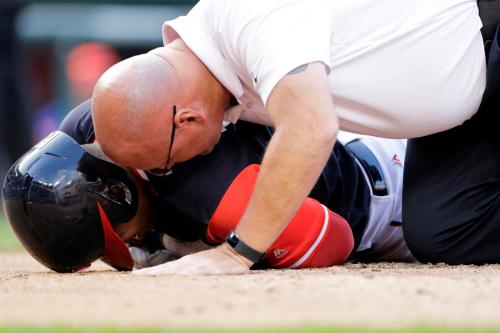
(AP Photo/Mark Tenally)
On Saturday, Nats batter Adrian Sanchez turned in towards a pitch as he attempted to bunt. But the 96-mph pitch headed straight for him, and the baseball struck him in the chest. He clutched his chest and collapsed to the ground where he remained for several minutes. An athletic trainer ran over, probably terrified of commotio cordis — a deadly injury caused by an unlucky strike to the chest in front of the heart.
Commotio cordis, Latin for “agitation of the heart,” is a bizarre condition where when a physical blow to the chest hits the heart during a particularly vulnerable moment in the heartbeat, it can cause a sudden heart attack.
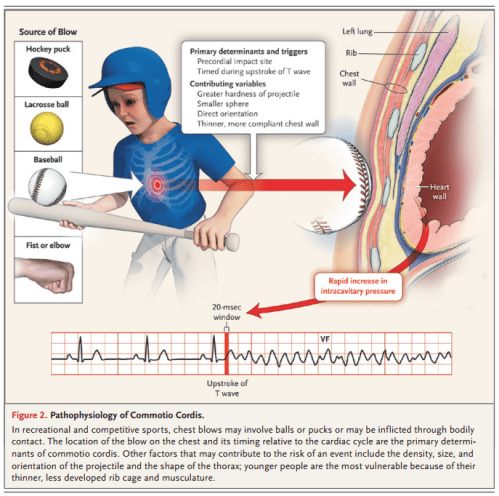
Maron and Estes, 2010
The heart attack isn’t due to physical damage; in fact, the blow usually doesn’t even damage the bones overlying the heart. Instead, scientist’s think that the mechanical energy generated from the strike affects proteins such as ion channels in the heart, causing them to function aberrantly, which ultimately leads to ventricular fibrillations.
Normally, heart cells in the ventricle normally are electrically synchronized so they contract together, and this unified contraction collapses the heart chambers and pumps blood. But in commotio cordis, the impact to the chest disrupts that synchronization. Different heart cells start contracting at different times from one another, and the heart can’t fully contract and efficiently pump blood. Instead, it fibrillates, with different regions making small ineffectual contractions. Defibrillators, those pads first-responders attach to the chest to “jump-start” the heart, work by sending an electrical signal over the heart which is strong-enough to re-synchronize the heart cells, so they again contract together and pump blood.
Sanchez, the Nats batter who was stuck by the pitch Saturday, recovered, and played out part of the rest of the game, even getting a base hit, before they sent him off to the hospital for monitoring, but not everyone is so lucky.
The very same day a 20-year-old Milwaukee Brewers minor-leaguer Julio Mendez was also struck by a pitch. An eye-witness report given on reddit said his breathing stopped, and trainers performed CPR as they waited for paramedics to arrive. The paramedics defibrillated the heart and took him to the hospital, where the Washington post reported today that he was in in a “critical but stable condition.”
Commotio cordis is a rare condition, but these two incidents are representative as younger players seem to be more vulnerable. According to the New England Journal of Medicine (NEJM), “it occurs primarily in children, adolescents, and young adults, most often during participation in certain recreational or competitive sports.” And of recreational and competitive sports, baseball is by far the most common cause of commotio cordis.
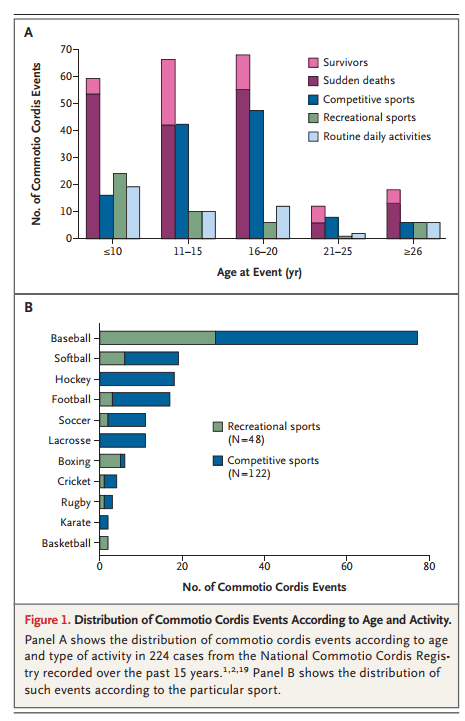
These deaths in young athletes may be preventable, according to that same NEJM article, “A direct relation between the hardness of the ball and the likelihood of ventricular fibrillation has been demonstrated in the laboratory, and lethal arrhythmias occur less frequently when the balls used have been manufactured for reduced hardness.” However, even softer baseballs made out of rubber as opposed to twine and cork have still caused commotio cordis.
In addition to recommending softer balls, the NEJM article suggests training young players to turn away from pitches coming at them, and also making defibrillators more available because quickly restarting the heart increases the chance of survival from any heart attack, including one induced by commotio cordis.
Filed under: Uncategorized | Leave a Comment
I don’t believe in free will
Just listened to the neuroscientist, Robert Sapolsky, talk about free will on Sam Harris’s podcast. Neither of them believe in free will and neither do I.

It started in high school with a thought experiment: if you rewound your life and woke up again this morning with no memory of what had happened today, would you do the exact same things?
Please stop and think about this scenario for a second. If you reset to this morning with your memory wiped, would you behave the same way?
If you said yes, then let’s rewind a week, a month, a year, all the way back to when you were born, your life is predestined. That’s it, we don’t need to talk about brains or consciousness, just follow simple logic.
Okay, so what if you said no? So even with the exact same personal history, and the exact same events going on around you, you made different decisions? Given the same inputs you choose different outputs? Then it seems like, you’re not making the best decisions given the scenario, you’re just behave randomly. And behaving randomly, doesn’t seem like free will. You might not live in a pre-determined world, but you live in an utterly random one.
But it feels like there’s free will, doesn’t it? Voluntary Actions
Filed under: Uncategorized | 9 Comments

Etymologically, schizophrenia comes from Greek skhizein and phren mind, so literally means “split mind,” and in popular culture, the term ‘schizophrenic,’ is often is used to refer to someone with multiple personalities.
However, schizophrenia has nothing to do with multiple personalities, instead it refers to a chronic mental health disorder with no cure that can involve hearing voices (auditory hallucinations), delusions, and disorganized thoughts.
It affects roughly 1% of the population, often appearing in early adulthood, and the symptoms can vary from person to person. These symptoms are usually split up into three categories: positive, negative, and cognitive. And, these distinctions are important because the medications used to treat schizophrenia can reduce positive symptoms, but give little relief to the “negative” or “cognitive” symptoms.
According to the National Institute of Mental Health, “positive” symptoms include hallucinations (usually auditory such as hearing voices), delusions, thought disorders and movement disorders.
While hallucinations and delusions can be some of the most frightening to patients and their families, “negative” and “cognitive” symptoms can be just as disruptive to work or social life.
Filed under: Uncategorized | 1 Comment
From talking to people in podcasts and radio, and reading people’s stories it seems like there are three ways to get jobs: applying to them, making something great, and persistence.
- Apply to Everything
First, check websites of shows or networks you like. For example:
- Gimlet: https://gimletmedia.com/careers/
- WNYC: http://www.wnyc.org/careers/
- NPR: http://www.npr.org/series/750004/careers
- Earwolf / Midroll: http://www.midroll.com/jobs/
- Panoply: http://panoply.fm/careers/
- Look for positions at your local NPR member’s station or other stations (See databases below).
- And also check out the #pubjobs on Twitter, though you will have to scroll by some British bartenders gigs. (And follow me, @neuroamer, while you’re there :))
Some shows or networks with recurring internships/fellowships:
- Maximum Fun: http://www.maximumfun.org/fellowship
- This American Life: https://www.thisamericanlife.org/about/fellowships
Listserves – Jobs, freelance gigs, and opportunities for collaboration are sometimes posted on listserves:
- AIRDaily Listserve – https://airmedia.org/airdaily/ (for paying members only)
- NYC Public Radio Listserve – https://groups.google.com/forum/#!forum/publicradionyc (requires an invite for some reason, so let me know if you want one)
- LADIO Listserve – for women in radio in NYC (you’ll have to get someone else to invite you to that one)
- Facebook has some, too: Public Media Millenials, Public Media Journalists
Databases – regional radio jobs are often also posted to a few databases:
- Media Bistro: https://www.mediabistro.com/jobs/
- Corporation for Public Broadcasting: http://www.cpb.org/jobline
- American Public Media Group: https://americanpublicmedia.applicantpro.com/jobs/
- Berkeley Journalism School’s Careers: https://journalism.berkeley.edu/career/jobs/
- Public Radio International: https://www.pri.org/work-us
Some jobs (though mostly ones that require a lot of experience) are posted in the classifieds of Nick Quah’s hotpod newsletter.

Pro tip: jackets can act as a mobile studio, and radio journalists are very resourceful and committed to their jobs.
2. Make something great
Pitching stories to shows you love can be a good way to meet producers and editors and show them how you work and think about stories. They might keep you in mind the next time something opens up on their show.
But, getting your foot in the door and getting your pitch read is hard. Knowing how to pitch is an art in itself. The biggest advice I can give is you need to pitch a story not an idea.
Continue reading ‘Three ways to get a job in podcasting or radio’
Filed under: Uncategorized | 2 Comments
Every week Dr. Karen Ring organizes a “sciparty” on twitter, where a scientists or science communicator who is active on twitter takes over the @sciparty account and answers questions for an hour on twitter.
Today, I hosted the science party and received a lot of questions about my decisions to pursue and drop out of an MD-PhD program and my experiences working on the podcast Science Vs and trying to get a start in science journalism. I’m going to try to share the questions and answers here, since it can be tricky to navigate them through twitter.
Me: I started in research as an undergrad studying electrosensory processing of the Little Skate Raja Erinacea.
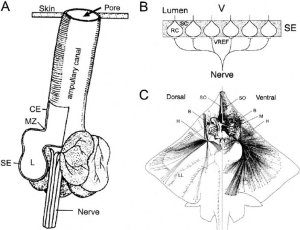
Interestingly the primary sensory area of their brain for electroreception is structured like mammalian cerebellum. As these fish move around and breath, they stimulate their own receptors, as if every time you breathed your vision filled with static. but just one synapse into the brain most of these self-generated signals are canceled out. Skates learn how movements affect receptors.
After undergrad, I worked as a technician in a lab that used mouse models to study genes thought to cause psychiatric diseases.
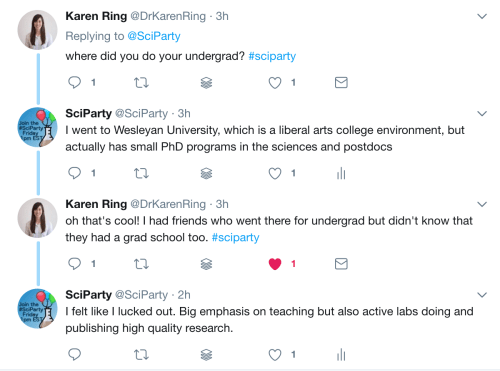
Continue reading ‘Hosting the 7/21/16 “sciparty” on Twitter:’
Filed under: Uncategorized | 2 Comments
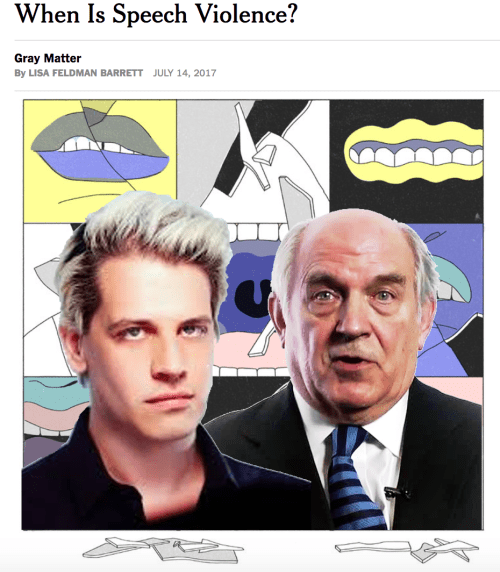
The knowing-speaking gap
Last night I went to taping of live Tech podcast that featured non-fiction author Douglas Rushkoff as a guest. (I’ll try to link to it once it get’s published). Overall, I felt the show was funny but in huge need of either fact-checking or authoritative guests, which Rushkoff was not. Unfortunately, it fell into an uncanny valley of edutainment — not accurate enough to be informative but the diversions into Rushkoff’s unreliable opinions stopped it from being funny enough to be entertaining. To be fair, producing a live show is difficult and it’s a new show finding it’s feet.
The show really drove home an issue that was a big difficulty for Science Vs, which I’ll call “the knowing-speaking gap.” When we looked for scientists for the show it was hard to find someone who was a good scientist and good talent — scientists that both knew their research and their field inside-out and were also able and willing to speak about it in an interesting and dynamic way. More broadly it seems like people who actually know things are unwilling or unable to speak about things and garner an audience that listens to them, and people who are great speakers and performers (and I’d count Rushkoff in this camp), often talk about everything, regardless of whether or not they know what they’re talking about.
Techno-pessimist alarmists will repeat and distort the same stories over and over. For the record, no, Target didn’t know a girl was pregnant before she did herself. Pregnancy hormones don’t alter our department store purchases in unconscious ways. As Forbes reported, Target did correctly target ads at a woman they suspected was pregnant because of the way she started conscientiously altered her shopping to prefer for the baby:
Continue reading ‘The “knowing-speaking gap” and the abuse of neuroscientific authority’
Filed under: Uncategorized | Leave a Comment
Exposure to toxic metals, like lead, have been linked to intellectual disability, and language, and behavioral problems, but the results of studies looking at whether toxic metals influence Autism Spectrum Disorders (ASDs) have been mixed. Other metals like manganese and zinc are essential minerals important for proper development and health. Until now, one of the difficulties has been that levels of metal exposure are often only measured after a child has received an ASD diagnosis, However, Sven Bölte and colleagues realized that after a child receives an ASD diagnosis, they could determine their early exposure to heavy metals by looking at the levels of the metals in the child’s baby teeth, as they describe in a paper published last month in Nature Communications.

Continue reading ‘Early metal exposure linked to autism using baby teeth’
Filed under: Uncategorized | Leave a Comment
I’m currently trying to go from working as an MD-PhD student to a science journalist. From thinking about disease and doing hands-on research to writing, thinking, and talking about those same conditions and studies.
I’ve struggled to explain why I’m making this switch. To come up with a single linear narrative that’s both satisfactory and honest for the switch. Like most things, it’s complicated.
One simple version:
I originally left the MD-PhD because of a health crisis. This gave me the time to really consider my path, and also really solidified in me something I intellectually knew but hadn’t felt before that point: that this was my one life, that I know myself better than anyone else does, and that only I can answer the question of what I should do with it.
Another thread: Continue reading ‘Trying Something New & Neuroscience Clothes’
Filed under: Uncategorized | 4 Comments
 Ben Kuebrich


 Neuroamer